Guide 2 of 3 · the calculator
3Draw with Equations
An equation is a drawing instruction: put a block everywhere this is true. The studio's graphing calculator turns one line of math into blocks on the same grid you paint and move by hand. You don't need to be good at math. You need about ten patterns, and they're all on this page.
01Where it lives
Panel: Graphing calculator → Plot an equation
- Type an equation in the box, or press one of the example buttons under it.
- Press Plot graph. The box tells you straight away if it can read what you typed.
- Drag to turn the result. Switch on X/Y/Z axes in the View / Telegraph Graph panel to see which way is which.
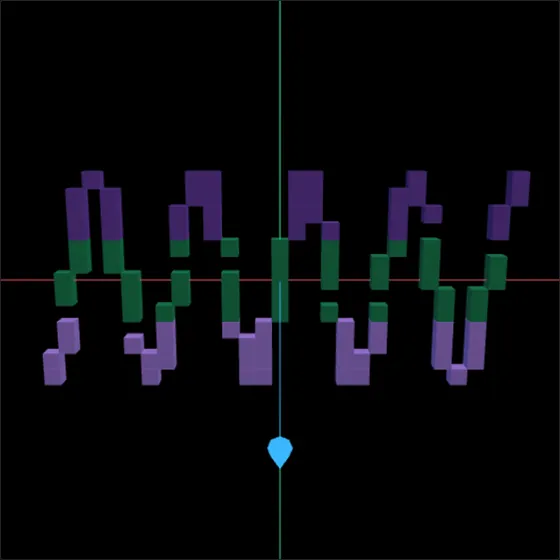
y = sin(x)*6 with the axes on. x runs across, y runs up, and z comes toward you.The grid runs from −14 to 14 on every axis, centred on the middle of the screen. Anything beyond that is cut off.
| You can use | Written as |
|---|---|
| Variables | x y z |
| Arithmetic | + − * / and ^ for powers. Always write the *: 2*x, never 2x. |
| Functions | sin cos tan · asin acos atan · sinh cosh tanh · sqrt cbrt abs · log exp · floor ceil round sign · min max pow |
| Constants | pi tau e |
Anything else is refused rather than guessed at. Equations typed into Text → object come out as lettering, not as a graph.
02Five kinds of drawing
What's on the left of the = decides what gets drawn.
| Form | Draws | Try |
|---|---|---|
| y = …x… | a line on the flat back plane: one height for each x | y = x^2/10 |
| x = …y… | the same, turned sideways | x = cos(y)*7 |
| z = …x, y… | a surface: one block for every spot on the floor, raised toward you | z = sin(x/2)*cos(y/2)*5 |
| … = … (x, y only) | a closed outline: every place the two sides match | x^2 + y^2 = 100 |
| … = … (with z) | a shell in 3D: every place the two sides match | x^2+y^2+z^2 = 144 |
Leave off the left side and the calculator picks for you. With only x it treats the line as y =; with y in it, as z =.
03Lines
Four moves shape any line. Try each on y = sin(x):
| To… | Change | Example |
|---|---|---|
| make it taller | multiply the whole right side | y = sin(x)*6 |
| stretch it wider | divide x | y = sin(x/2)*6 |
| move it up | add at the end | y = sin(x/2)*6 + 4 |
| slide it right | subtract from x | y = sin(x - 3)*6 |
y = x^3/50 leaves gaps where it climbs fast. Move everything to one side, y - x^3/50 = 0, and it becomes an outline that fills every block it passes through.04Closed shapes
With an = between two sides and no z, you get every spot where they match: outlines. A circle is every point the same distance from the middle. That's x^2 + y^2 = r^2, so for radius 10 you write x^2 + y^2 = 100.
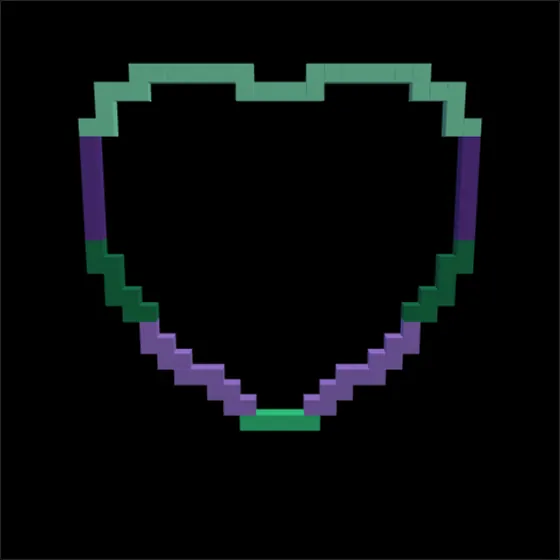
((x/10)^2 + (y/10)^2 - 1)^3 = (x/10)^2*(y/10)^3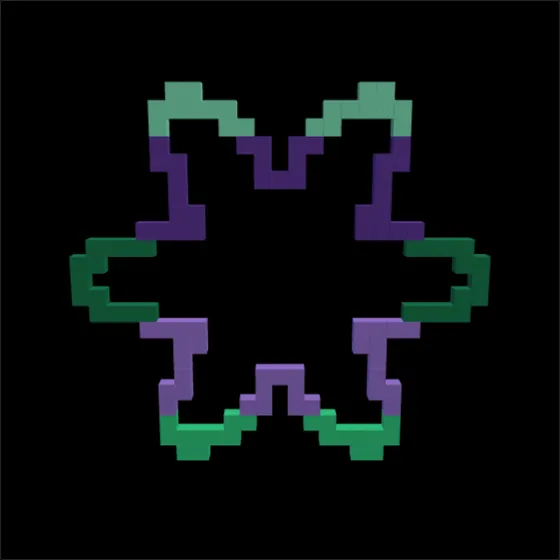
sqrt(x^2+y^2) = 9 + 3*cos(6*atan(y/x))Circle, moved
(x-4)^2 + (y+2)^2 = 25Radius 5, centred at x 4, y −2. Subtract to move right, add to move down.
Oval
x^2/144 + y^2/49 = 112 wide each side, 7 tall. The numbers under x and y are the half-widths squared.
Diamond
abs(x) + abs(y) = 10abs folds the drawing into all four corners at once.
Square
max(abs(x), abs(y)) = 10The bigger of the two distances reaching 10 is a square.
Flower
sqrt(x^2+y^2) = 9 + 3*cos(6*atan(y/x))Distance from the middle wobbles 6 times around. Use an even petal count: atan only sees half a turn, so odd counts come out uneven.
Hyperbola
x^2 - y^2 = 25Two curves bending away from each other.
05Landscapes
z = … gives every spot on the grid a height. Heights rise toward you, so the result reads like a relief map seen from overhead. Press ▲ a few times, or drag down, to look at it from the side.
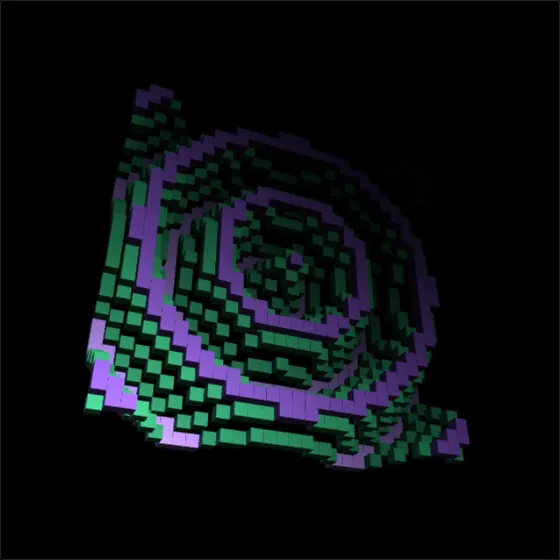
z = 3*cos(sqrt(x*x + y*y)) — a pond after a stone. The square root is the distance from the middle.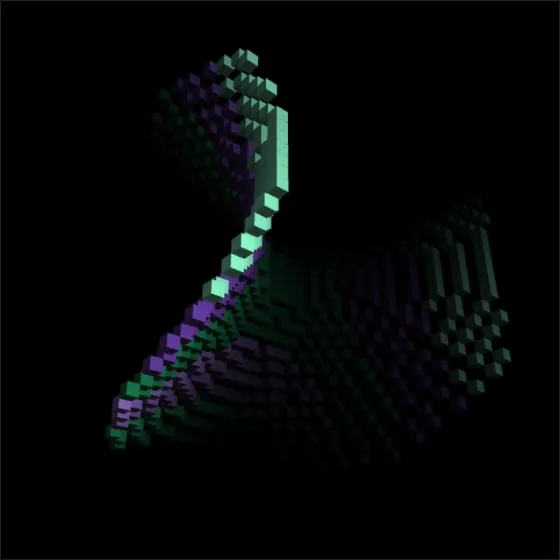
z = (x*x - y*y)/10 — a saddle. Its corners pass ±14, so they're cut off.Hill
z = 8*exp(-(x*x+y*y)/40)Tall in the middle, fading smoothly to flat. The 40 sets how wide.
Dome
z = 10 - (x*x + y*y)/20A rounded cap that drops off toward the edges.
Pyramid
z = 10 - max(abs(x), abs(y))The square recipe, used as a height.
Stairs
z = floor(x/3)*2floor snaps a slope into steps 3 wide and 2 high.
Egg crate
z = sin(x/2)*cos(y/2)*5Bumps and dips in a grid.
Flat sheet
z = 6A plane floating 6 in front of the back wall. Good for a backdrop.
06Balls, rings and tubes
Put z into an equation with an = and you get a shell: every block where the two sides match, in all three directions.
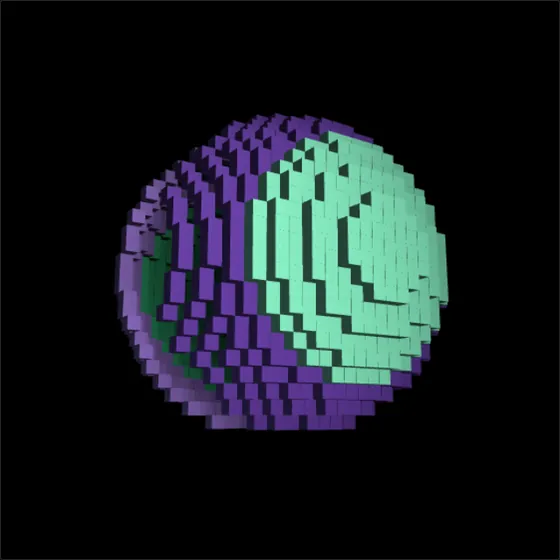
x^2+y^2+z^2 = 144 — every block 12 from the middle.Egg / pebble
x^2/169 + y^2/81 + z^2/36 = 1A ball squashed to 13 wide, 9 tall, 6 deep.
Ring (torus)
(sqrt(x^2+y^2) - 8)^2 + z^2 = 9A doughnut facing you: 8 out to the middle of the tube, tube radius 3.
Double cone
x^2 + y^2 = z^2Two cones point to point at the centre.
Box
max(abs(x), abs(y), abs(z)) = 10The square recipe with a third direction: a hollow cube.
The one rule to know: the calculator looks along z
To find a shell, the calculator runs down each line of blocks pointing toward you and marks where the equation flips from inside to outside. A wall that lies along that line never flips, so it comes out as a few scattered posts.
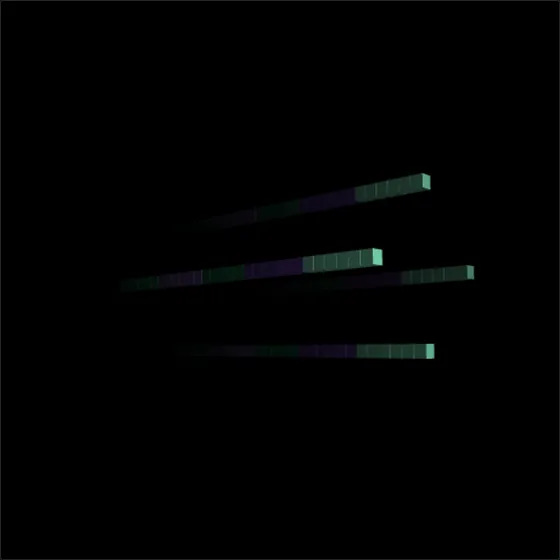
x^2 + y^2 + 0*z = 36 — a tube pointing at you draws only four lines.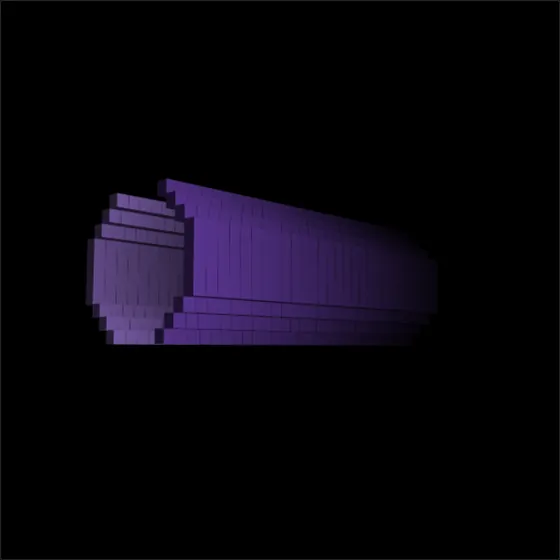
y^2 + z^2 = 36 — the same tube laid along x comes out whole.07Build objects: min and max
This is where equations start to feel like drawing. First, write each shape as something = 0 by moving the number across: the ball x^2+y^2+z^2 = 144 becomes x^2+y^2+z^2-144. That expression is negative inside the shape and positive outside. Then:
| You want | Write |
|---|---|
| both shapes (A and B stuck together) | min(A, B) = 0 |
| only where they overlap | max(A, B) = 0 |
| A with B carved out of it | max(A, -B) = 0 |
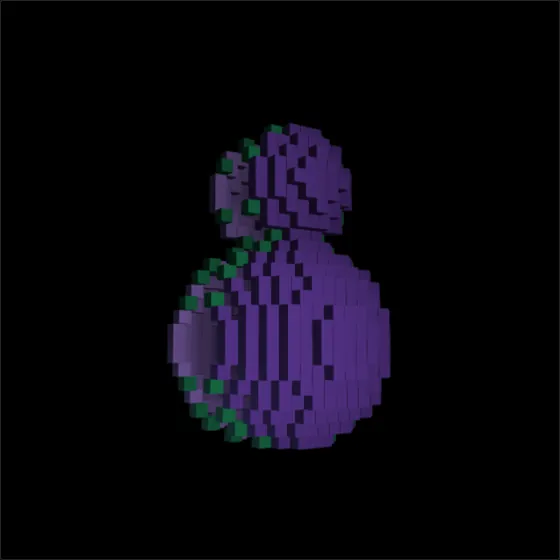
min(x^2+(y+5)^2+z^2-64, x^2+(y-7)^2+z^2-25) = 0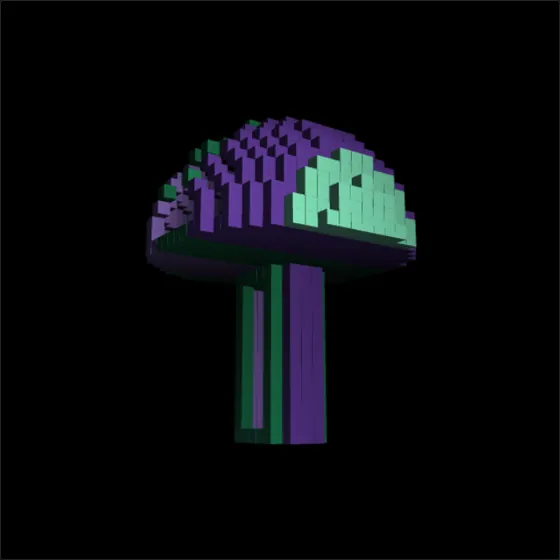
min(max(x^2+z^2-9, abs(y+6)-6), max(x^2+(y-2)^2+z^2-100, -(y-2))) = 0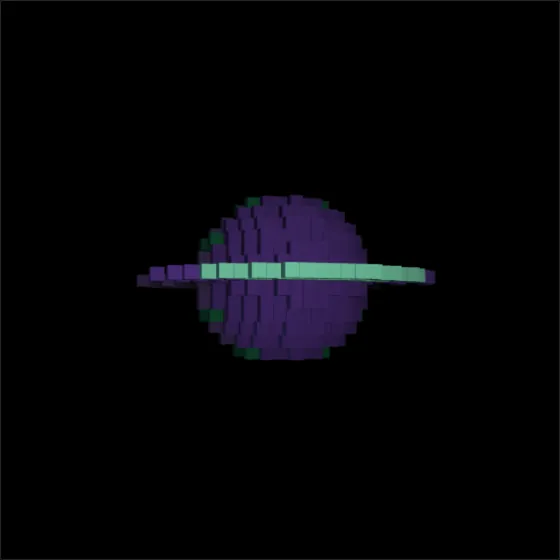
min(x^2+y^2+z^2-49, abs(y) + (sqrt(x^2+z^2)-11)^2 - 1) = 0Reading the mushroom
- Stem:
max(x^2+z^2-9, abs(y+6)-6)is a round post of radius 3, cut to the stretch between y −12 and 0.maxkeeps only the part inside both. - Cap:
max(x^2+(y-2)^2+z^2-100, -(y-2))is a ball of radius 10 centred at y 2, with everything below y 2 cut off. That leaves a dome with a flat underside. - Together: the outer
min( stem , cap ) = 0keeps both.
Half dome
max(x^2+y^2+z^2-144, -y) = 0A ball with everything below the middle carved off.
Bitten apple
max(x^2+y^2+z^2-100, -((x-9)^2+y^2+z^2-25)) = 0A ball with a smaller ball taken out of its side.
08After you plot
What you plot is ordinary blocks on the graph, so everything in 3Draw in the Studio works on it:
- Paint the snowman's buttons and nose with Select mode and Selected voxel color.
- Nudge pieces with X± Y± Z±, or Grow just the cap of the mushroom.
- Scatter it with Entropy scramble, then Snap it back.
- Light it from Light Settings, and export an STL to print it.
Your last drawing's recipe, equation included, is kept on your device, so the studio can rebuild it next visit.
09When it goes wrong
| What happens | Likely cause and fix |
|---|---|
| “Not readable as an equation” | A missing * (2x → 2*x), a bracket left open, a letter other than x y z, or a double ==. |
| Part of the shape is missing | It runs past ±14. Make it smaller: divide the numbers, or use a smaller radius (= 144 is radius 12). |
| Only a few posts appear | The walls run along z. Lay the shape on its side (see the z rule). |
| A line has gaps | It's too steep for y = …. Write it as y - (…) = 0. |
| Nothing at all | The two sides never match inside the grid. x^2 + y^2 = -4 has no answers; check the signs. |
10Recipe card
Press Copy and paste into the calculator.
Wave
y = sin(x/2)*6Heart
((x/10)^2 + (y/10)^2 - 1)^3 = (x/10)^2*(y/10)^3Flower
sqrt(x^2+y^2) = 9 + 3*cos(6*atan(y/x))Pond
z = 3*cos(sqrt(x*x + y*y))Hill
z = 8*exp(-(x*x+y*y)/40)Ball
x^2+y^2+z^2 = 144Ring
(sqrt(x^2+y^2) - 8)^2 + z^2 = 9Snowman
min(x^2+(y+5)^2+z^2-64, x^2+(y-7)^2+z^2-25) = 0Mushroom
min(max(x^2+z^2-9, abs(y+6)-6), max(x^2+(y-2)^2+z^2-100, -(y-2))) = 0Planet
min(x^2+y^2+z^2-49, abs(y) + (sqrt(x^2+z^2)-11)^2 - 1) = 0